

Dealing with the Aftermath Tragedies like airplane crashes can make you feel powerless. Large airlines and insurance companies often have massive legal teams. Meanwhile, you simply want to rebuild your life.
Understanding Your Rights Fortunately, you have rights. The legal system allows you to hold negligent parties accountable. Often, a settlement offers the best path to justice.
How This Guide Helps We wrote this guide to explain airplane crash settlements clearly. It shows how settlements provide financial stability and closure. We also break down the factors that determine a fair amount. Finally, you will learn how a dedicated lawyer fights for you.
Overview
- Key Takeaways
- What Is an Airplane Crash Settlement?
- What Kind of Compensation Can You Receive?
- What Factors Determine Your Settlement Amount?
- Who Is Eligible to File a Claim?
- What Evidence Builds a Strong Case?
- Settling vs. Going to Trial: Which Path Is Right for You?
- What Are the Steps in the Settlement Process?
- Overcoming Common Challenges in Your Case
- Finding Support After an Airplane Crash
- Key Legal Rules for Airplane Crash Claims
- Frequently Asked Questions
Key Takeaways
- A fair settlement accounts for your entire recovery journey: It’s designed to cover not only your immediate medical bills and lost wages but also the long-term financial and emotional impact the accident has on your life.
- Identifying fault is the foundation of your claim: Unlike a typical accident, a plane crash can involve multiple responsible parties—from the airline to the manufacturer—and a thorough investigation is necessary to hold them all accountable.
- Act quickly to protect your rights: Strict legal deadlines apply to aviation claims, and insurance companies often pressure victims into low settlements. Speaking with an attorney early ensures your claim is filed correctly and you are protected from these tactics.
What Is an Airplane Crash Settlement?
After an aviation disaster, the path toward financial recovery can feel overwhelming. One of the most common ways to resolve a plane accident claim is through a formal settlement.
A settlement is a binding agreement to resolve your legal case outside of a courtroom. Instead of leaving the final decision to a judge or jury, you and the responsible parties—which may include the airline, aircraft manufacturer, or maintenance company—agree on a specific amount of compensation.
The process of securing plane crash lawsuit settlements involves your attorney presenting detailed evidence of your losses and negotiating on your behalf. The goal is to secure a fair amount that addresses the physical, emotional, and financial harm you have suffered.
This provides a structured way to obtain the resources you need to move forward, while avoiding the long-term uncertainty and stress of a public trial.
| Title | Data |
|---|---|
| Total U.S. civil aviation accidents | Approximately 1,200 accidents nationwide |
| Total U.S. aviation fatalities | Around 300 to 350 deaths per year |
| Percentage of crashes involving general aviation | About 80 percent of all U.S. airplane accidents |
| Commercial airline passenger fatalities | Typically zero in recent years |
| Fatal accident rate for general aviation | Less than 1 fatal accident per 100,000 flight hours |
| Number of general aviation aircraft in the U.S. | Over 200,000 registered aircraft |
Defining a Settlement and What It Covers
A settlement is the financial compensation you receive for the injuries and losses resulting from an airplane crash. This isn’t just about covering immediate hospital bills; it’s designed to address the full scope of the accident’s impact on your life.
The funds can cover a wide range of damages, including all current and future medical expenses, lost wages if you’re unable to work, and the cost of long-term care or rehabilitation.
Beyond these tangible costs, a settlement also accounts for the profound personal suffering involved. This includes compensation for physical pain, emotional distress, and the loss of enjoyment of life. In tragic cases of wrongful death, a settlement provides financial support for the surviving family members.
Settlement vs. Trial: What’s the Difference?
Deciding whether to accept a settlement or take your case to trial is a major decision you’ll make with your legal team.
A settlement is a private negotiation that typically resolves your claim much faster and with less expense than a trial. You get a predictable outcome without the risk of a jury trial. However, the airline or other at-fault parties do not have to publicly admit they were wrong.
Going to trial means a judge and jury will hear your case and decide the outcome. While a successful lawsuit can sometimes result in a higher compensation award, it’s a much longer process that can take years to complete. Trials are also public and carry the risk that you could lose and receive nothing. An experienced aviation accident attorney can help you weigh these options.
What Kind of Compensation Can You Receive?
After a traumatic event like an airplane crash, the path to recovery can feel overwhelming. A settlement is designed to provide financial support to cover the wide range of losses you and your family have experienced.
These losses are categorized into different types of “damages” in a personal injury claim. Understanding what you may be entitled to is a critical first step in seeking the compensation you deserve. Let’s break down the three main types of compensation you can receive.
Economic Damages
Economic damages are the most straightforward type of compensation because they cover the tangible financial losses you’ve incurred. Think of these as the costs with clear price tags attached. This includes all current and future medical expenses, from emergency room visits to long-term rehabilitation.
It also covers lost income if you’re unable to work and, in the most tragic cases, the funeral and burial costs associated with a wrongful death. The goal here is to restore the financial stability that was disrupted by the accident, ensuring you aren’t burdened by bills while you focus on healing.
Non-Economic Damages
Some of the deepest impacts of an airplane crash aren’t financial. Non-economic damages are meant to compensate for the profound personal suffering that doesn’t come with a receipt. This includes the physical pain and emotional distress you’ve endured, such as anxiety, depression, or PTSD.
For families who have lost a loved one, it can also cover the loss of companionship and support. While no amount of money can erase this pain, these damages acknowledge the immense psychological and emotional toll an accident takes on victims and their families, including those dealing with life-altering brain injuries.
Punitive Damages
Punitive damages are different from the other two categories. They aren’t intended to compensate you for a specific loss but to punish the at-fault party for extreme recklessness or intentional misconduct.
These are only awarded in cases where the defendant’s behavior was particularly outrageous—for example, an airline knowingly ignoring critical safety regulations or a manufacturer using a defective part they knew was faulty.
The purpose of punitive damages is to hold the responsible party accountable in a significant way and to deter them and others from engaging in similar dangerous conduct in the future. These are less common but can be substantial in serious aviation accidents.
What Factors Determine Your Settlement Amount?
When you’re recovering from an aviation accident, it’s natural to wonder what a fair settlement looks like. The truth is, there’s no simple calculator for these cases. The final amount depends on a unique combination of factors, from the severity of your injuries to the specific circumstances of the crash. Think of it less as a fixed price and more as a detailed assessment of everything you’ve lost.
To determine the value of a claim, we look at three main areas. First is the human impact—the physical, emotional, and financial toll the accident has taken on you and your family. Second, we have to identify who was at fault, which can be a complex process involving multiple parties.
Finally, a specific set of federal and international laws governs aviation incidents, and these rules play a significant role in shaping the outcome of your case. Understanding how these elements work together is the first step toward building a strong claim.
The Impact of Your Injuries
The nature and severity of your injuries are the foundation of your settlement value. A case involving minor injuries will be valued differently than one involving life-altering harm.
Compensation is meant to cover tangible costs like medical bills and lost wages, as well as the profound, non-economic impact on your quality of life. While every situation is different, settlement amounts can range from hundreds of thousands for less severe injuries to millions for catastrophic ones.
For example, cases involving serious or catastrophic injuries often result in settlements between $1 million and $10 million. In the tragic event of a fatality, a wrongful death claim may be valued even higher to account for the family’s immense loss.
These figures reflect the long-term medical care, loss of future income, and deep personal suffering involved. An experienced attorney can help you document the full extent of your damages to ensure your settlement reflects what you truly need to recover.
Determining Who Is at Fault
Identifying the responsible party in an airplane crash is rarely straightforward. Unlike a typical car accident, an aviation incident can involve a long chain of potential negligence. Was it a pilot error? A mechanical failure due to a manufacturing defect?
Did the airline’s maintenance crew cut corners? Or was there a mistake by air traffic controllers on the ground? Each of these possibilities points to a different at-fault party.
Plane crash litigation presents unique challenges because of the complexity of aircraft systems and the number of companies and agencies involved. A thorough investigation is required to pinpoint the cause and prove liability.
Our job is to untangle this web of responsibility to hold the right parties accountable, whether it’s the airline, an aircraft manufacturer, or a third-party contractor. Successfully establishing fault is critical to securing the compensation you deserve for your aviation accident injuries.
Airline Negligence and Federal Rules
Aviation law is a highly specialized field with its own set of federal and international rules that can significantly influence your case. For instance, if an air traffic controller or another federal employee is found to be at fault, your claim may fall under the Federal Tort Claims Act (FTCA).
This act provides a legal path for individuals to seek compensation from the U.S. government for negligence, but it comes with specific procedures and limitations.
Furthermore, the applicable laws can change depending on where the crash occurred, the airline’s home country, and your own residency. An accident on an international flight, for example, may be governed by treaties like the Montreal Convention, which sets different rules for liability and compensation.
These legal layers add complexity to your claim, making it essential to work with a legal team that understands the specific regulations that apply to your situation.
Who Is Eligible to File a Claim?
After an airplane crash, figuring out your legal options can feel overwhelming. The law provides paths for both those who were injured and the families of those who were lost to seek accountability and financial support. Generally, two groups of people are eligible to file a claim: survivors of the incident and the close family members of victims who did not survive.
Each path involves different legal considerations, but both are designed to address the immense losses suffered. Understanding where you fit and what you’re entitled to is the first step toward recovery. The rules can be complex, so knowing your rights is crucial.
Survivors of the Crash
If you were a passenger who survived an airplane crash, you have the right to file a claim for the harm you’ve endured. This isn’t just about the immediate physical injuries; it’s about the full scope of how the incident has affected your life.
Compensation can cover tangible costs like medical bills, physical therapy, and any wages you lost while unable to work. It also addresses the non-physical trauma, including pain, suffering, and emotional distress.
These types of accidents often result in severe and long-lasting conditions, such as brain injuries or other catastrophic harm, and a settlement is meant to provide the resources you need for your recovery journey.
Family Members in Wrongful Death Claims
When a person dies in an aviation accident, their surviving family members may be able to file a wrongful death claim. This type of legal action seeks compensation for the losses the family has suffered due to their loved one’s death.
A successful claim can help cover immediate expenses like funeral and burial costs. More importantly, it can provide for the future by replacing the financial support the deceased would have provided over their lifetime. It also acknowledges the profound loss of companionship, guidance, and care.
While no amount of money can replace a loved one, a wrongful death claim can offer a sense of justice and financial stability during an incredibly difficult time.
Understanding the Time Limits to File
It’s critical to know that you don’t have an unlimited amount of time to take legal action. Each state has a law called the “statute of limitations,” which sets a strict deadline for filing a personal injury or wrongful death lawsuit.
In many cases, this deadline is two or three years from the date of the accident. However, the timeframe can be shorter or longer depending on the specific circumstances of the crash. For example, if your claim is against a government entity, the rules and deadlines are different. International flights are also governed by separate treaties that have their own time limits.
Missing this deadline means you could lose your right to file a claim forever, so it’s important to get clear legal advice on your specific situation as soon as possible.
What Evidence Builds a Strong Case?
When you’re seeking a settlement, the strength of your case depends on the evidence you can present. It’s not enough to simply state what happened; you need to prove it. A thorough investigation uncovers the facts needed to establish who is at fault and demonstrate the full impact the crash has had on your life.
This involves gathering different types of proof, from technical data to personal accounts, to build a clear and compelling story for insurance companies and, if necessary, the courts.
Medical Records and Expert Opinions
Your health and well-being are the top priority, and your medical records are a critical piece of your claim. These documents create an official timeline of your injuries, treatments, and recovery process. They show the physical and financial toll of the accident, detailing everything from initial emergency care to ongoing physical therapy.
For complex injuries, we often work with medical experts who can explain the long-term effects of your condition. This is especially important in cases involving catastrophic injuries, as their testimony helps calculate future medical costs and lost earning capacity, ensuring your settlement covers your needs for years to come.
Airline Records and Maintenance History
Figuring out why a plane crashed requires a deep look into technical details. Aviation accidents are often complex, involving layers of potential failures. Your legal team will seek access to crucial airline records, including the plane’s maintenance history, repair logs, and the flight data recorder (the “black box”).
We also examine pilot training records, crew schedules, and communication logs. This evidence can reveal if the crash was caused by mechanical failure, improper maintenance, or human error. Uncovering a pattern of negligence or a violation of federal safety regulations is key to holding the responsible parties accountable for their actions and building a solid foundation for your claim.
Official Reports and Witness Accounts
After a crash, government agencies like the National Transportation Safety Board (NTSB) conduct exhaustive investigations. Their final reports provide an objective analysis of the incident and often pinpoint the probable cause.
These official findings are powerful evidence in a personal injury claim. Alongside these reports, firsthand accounts from survivors, other passengers, and eyewitnesses on the ground can be incredibly valuable. They provide a human perspective that data logs can’t capture.
In wrongful death claims, these personal stories help illustrate the full scope of the tragedy and its impact on the families left behind, giving a voice to those who can no longer speak for themselves.
Settling vs. Going to Trial: Which Path Is Right for You?
After an airplane crash, one of the most significant decisions you and your legal team will face is whether to accept a settlement or take your case to trial. Most personal injury cases, including those involving aviation accidents, are resolved through a settlement.
However, understanding the benefits and drawbacks of each path is essential for making the choice that best aligns with your goals for recovery and justice.
This decision isn’t made in a vacuum; it’s a strategic choice based on the strength of your evidence, your financial needs, and your emotional readiness for a potential court battle. An experienced attorney will walk you through the specifics of your case, helping you weigh the certainty of a settlement against the potential outcomes of a trial.
The Pros of Settling Your Case
The primary advantage of settling your case is certainty. A settlement provides a definite amount of compensation on a much faster timeline than a trial. This allows you to cover medical bills, lost wages, and other expenses without the prolonged stress and uncertainty of litigation. Settlements are also private, meaning the details of your agreement won’t become part of the public record.
This can be a significant relief for families who wish to maintain their privacy during a difficult time. The trade-off is that the compensation might be less than what a jury could potentially award, and the airline may not have to publicly admit fault for the incident.
The Pros of Taking Your Case to Trial
Taking your case to trial can sometimes lead to a larger financial award if a jury rules in your favor. A public trial can also create a sense of public accountability for the at-fault parties, which can be an important part of the healing process for some survivors and their families. However, this path carries significant risks. Trials can take years to conclude, and the outcome is never assured.
There is always a chance that a jury could award less than the settlement offer or find that the defendant is not liable at all, leaving you with no compensation. Pursuing a trial requires a strong stomach for uncertainty and a willingness to see a difficult process through to the end.
Comparing Timelines and Costs
The vast majority of personal injury claims—around 95%—are resolved through a settlement before ever reaching a trial. This is largely because trials are expensive and time-consuming for everyone involved. The legal fees, court costs, and expert witness fees associated with a trial can be substantial. A settlement avoids many of these costs and provides a resolution in months rather than years.
Deciding which path is right for you involves weighing the potential for a higher award at trial against the speed, certainty, and lower cost of a settlement. Discussing the unique details of your case with an experienced aviation accident attorney can help you make a fully informed decision.
What Are the Steps in the Settlement Process?
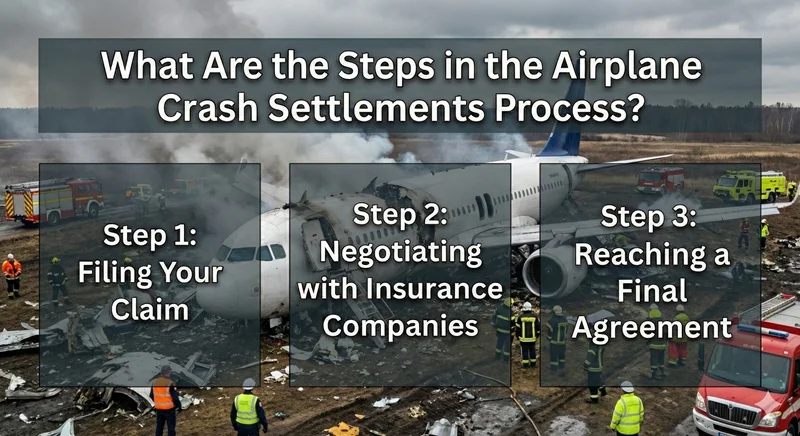
After an airplane crash, the path to receiving compensation follows a series of clear, structured steps. While every case is unique, the settlement process generally involves filing your claim, negotiating with the responsible parties, and reaching a final agreement.
Understanding these stages can help you feel more prepared for what lies ahead. Having an experienced legal team manage this process allows you to focus on your recovery while we handle the complex details and fight for the compensation you deserve.
Step 1: Filing Your Claim and Starting the Investigation
The first formal step is to file a legal claim against the parties at fault. This action officially begins the process and triggers a deep investigation into the cause of the crash. Our team gets to work immediately, gathering crucial evidence like maintenance logs, flight data recordings, and witness statements. A thorough investigation is the foundation of a strong case.
Taking the time to build a solid claim from the start is essential, as it directly impacts your ability to secure fair compensation for your injuries and losses from an aviation accident.
Step 2: Negotiating with Insurance Companies
Once the initial investigation is underway, we begin negotiations with the airline’s and other at-fault parties’ insurance companies. This stage can be challenging, as insurers often try to minimize what they have to pay. We handle all communications and push back against lowball offers.
Because the vast majority of personal injury cases are resolved before ever reaching a courtroom, strong negotiation is critical. We present the evidence from our investigation to demonstrate the full extent of your damages and argue for a settlement that truly reflects what you’ve been through.
Step 3: Reaching a Final Agreement
The goal of negotiations is to reach a final settlement agreement that you approve. With around 95% of cases settling before trial, this is the most common outcome. A final agreement is a legally binding resolution that provides you with compensation without the time and stress of a full trial.
We will walk you through every offer and provide the guidance you need to make an informed decision. If you’re ready to discuss your case and learn how we can help you through this process, we offer a free consultation to get you started.
Overcoming Common Challenges in Your Case
The path to securing a fair settlement after an airplane crash is rarely straightforward. You’re likely facing immense personal challenges while also trying to understand a complex legal process. It’s completely normal to feel overwhelmed. Knowing the common hurdles ahead of time can help you prepare for what’s next and make informed decisions for yourself and your family.
From dealing with aggressive insurance adjusters to untangling who is truly at fault, these obstacles are designed to be difficult.
Insurance companies and other liable parties have teams of lawyers working to protect their interests, which often means minimizing what they pay to victims. On top of that, the physical and emotional weight of the accident can make it feel impossible to fight for your rights. Recognizing these challenges is the first step toward building a strategy to overcome them and protect your future.
Dealing with Insurance Company Tactics
Soon after a crash, you can expect to hear from insurance companies. They may sound helpful and concerned, but their primary goal is to settle your claim for as little as possible. A common tactic is to offer a quick, lowball settlement before you’ve had a chance to understand the full extent of your injuries or your long-term needs.
They know that victims are vulnerable and may be tempted by an immediate payout. Accepting this early offer usually means signing away your right to any future compensation, even if your medical costs turn out to be much higher. It’s critical to avoid making any recorded statements or signing documents without speaking to an attorney first. A free consultation can help you understand your rights.
Handling Cases with Multiple At-Fault Parties
Airplane crashes are rarely caused by a single error. Liability often spreads across multiple parties, including the airline, the aircraft manufacturer, a maintenance company, or even government entities like air traffic control.
Proving fault can be incredibly difficult when each party’s legal team is working to shift the blame elsewhere. A successful claim requires a deep investigation to identify every responsible entity and hold them accountable.
An experienced legal team knows how to gather evidence, consult with aviation experts, and build a case that shows exactly how each party contributed to the accident. This is a crucial step in pursuing the full compensation you deserve for your aviation accident claim.
The Toll of Emotional and Physical Trauma
Beyond the legal complexities, you are also dealing with the immense personal impact of the accident. Recovering from serious physical injuries is a long and painful process, and the emotional trauma can be just as debilitating.
The aftermath of a plane crash often involves not only physical pain but also significant emotional distress, including PTSD, anxiety, and grief. Trying to manage a demanding legal case while focusing on your health is an unfair burden. Your priority should be your recovery.
This is why finding a legal team that handles every detail of your case—from paperwork to negotiations—is so important. It allows you to dedicate your energy to healing, knowing your legal fight is in capable hands, especially when dealing with catastrophic injuries.
Historical High-Value Aviation Settlements and Case Benchmarks
To understand the potential value of an aviation claim, it is helpful to look at the historical benchmarks set by major commercial disasters. Historically, aviation settlements are among the highest in personal injury law due to the catastrophic nature of the accidents and the complex liability of airlines and manufacturers.
For instance, following the Lion Air Flight 610 and Ethiopian Airlines Flight 302 (Boeing 737 MAX) crashes, settlements for individual families have reportedly ranged from $1.2 million to over $15 million per victim, depending on the decedent’s age, earning potential, and the presence of dependents.
High-profile disasters like the 1996 ValuJet Flight 592 crash resulted in a total payout exceeding $110 million, while the Pan Am Flight 103 (Lockerbie) settlement remains one of the largest in history at $2.7 billion (averaging $10 million per family).
On average, while a “minor” private jet or commercial injury claim involving non-life-threatening injuries might settle for $50,000 to $500,000, wrongful death settlements in commercial aviation disasters typically average between $2 million and $5 million. These figures vary significantly based on the specific jurisdiction and the findings of the NTSB investigation.
Finding Support After an Airplane Crash
The aftermath of an airplane crash is overwhelming, leaving survivors and their families to deal with physical injuries, emotional trauma, and a mountain of questions. While the path forward can feel uncertain, you don’t have to walk it alone.
A strong support system is crucial for recovery, and it comes in many forms—from legal guidance that protects your rights to emotional support that helps you heal. Understanding where to find this help is the first step.
Navigating the legal system, accessing financial assistance, and processing the emotional impact of the event are all significant challenges. Fortunately, there are dedicated resources available to help you with each aspect of your recovery.
Whether you need an attorney to handle the complexities of your claim, information on government assistance programs, or a professional to talk to, support is within reach. Building this network allows you to focus on what matters most: your well-being and that of your family.
Getting the Right Legal Help
Aviation law is incredibly complex, involving federal regulations, international treaties, and multiple potentially at-fault parties. An experienced aviation accident attorney can guide you and your family through the process of recovering the compensation you deserve.
They handle the investigation, communicate with insurance companies, and build a strong case on your behalf. This allows you to step back from the legal battle and concentrate on your physical and emotional recovery. Having a skilled legal team in your corner ensures your rights are protected every step of the way.
Victim Assistance and Government Programs
Following a major aviation incident, several federal programs are activated to help survivors and victims’ families. The National Transportation Safety Board (NTSB), for example, provides a range of services through its Office of Transportation Disaster Assistance. These programs can offer crisis counseling, help with travel arrangements, and provide timely information about the investigation.
They serve as a central point of contact, helping families get answers and access critical resources without having to manage multiple agencies on their own. These services are designed to ease the logistical and emotional burdens during an incredibly difficult time.
Counseling and Emotional Support Networks
The psychological trauma from an airplane crash can be profound and long-lasting for both survivors and the families of victims. Seeking professional counseling is a vital part of the healing process. Therapists specializing in trauma and PTSD can provide you with coping strategies and a safe space to process your experience.
Additionally, connecting with support networks and advocacy groups can be incredibly helpful. These organizations offer a community of people who understand what you’re going through, providing a sense of solidarity and shared strength as you move toward recovery and justice.
Key Legal Rules for Airplane Crash Claims
Airplane crash claims are rarely straightforward. The laws that apply can change dramatically depending on who was responsible and where the accident happened. Unlike a typical car accident, an aviation accident often involves federal regulations, international treaties, and powerful corporate defendants. Understanding these key legal rules is the first step in holding the right parties accountable.
Because multiple factors can contribute to a crash—from pilot error and poor maintenance to faulty equipment and air traffic control mistakes—identifying every liable party is crucial. Each type of defendant comes with its own set of legal standards and procedures.
For example, suing a government entity is very different from filing a claim against a private manufacturer. An experienced legal team can help you sort through these complexities to build the strongest possible case for the compensation you deserve.
Claims Against the Government (FTCA)
Sometimes, the fault for a plane crash lies with a government entity. When federal employees, such as air traffic controllers working for the Federal Aviation Administration (FAA), make a mistake that leads to a disaster, you can’t just file a standard lawsuit. Instead, your claim is governed by the Federal Tort Claims Act (FTCA).
This law provides a specific path for victims and their families to seek compensation directly from the U.S. government. The FTCA has strict procedural rules and deadlines that must be followed precisely, making it essential to have legal guidance from the very beginning.
Claims Against Aircraft Manufacturers
If a crash is caused by a mechanical failure or a design flaw, the company that built the plane or its components can be held responsible. These product liability claims argue that the aircraft was defective and unsafe for its intended use.
Pursuing a lawsuit against a large manufacturer can be a complex fight, but it’s often necessary to secure fair compensation for the catastrophic injuries that result from these failures. A successful claim can cover medical bills, lost income, and the immense pain and suffering you’ve endured, often resulting in a higher recovery than an initial settlement offer.
When an Accident Crosses Borders
When a plane crash involves international travel, the case becomes even more complicated. The laws that determine your compensation can vary based on where the crash occurred, the airline’s country of operation, and even your own country of residence. International treaties, like the Montreal Convention, often dictate the airline’s liability and the amount of damages that can be recovered.
These rules can be confusing and may limit your options, which is why it’s so important to work with a legal team that understands how to handle claims involving wrongful death and injuries on an international scale.
Frequently Asked Questions
Accidents involving international travel are governed by a different set of rules, often under treaties like the Montreal Convention.
These laws can affect who is held liable and the types of compensation you can receive. This adds a significant layer of complexity to a case, making it crucial to work with a legal team that has specific experience with the laws that apply to international aviation incidents.
Most airplane crash cases—around 95%—are resolved through a settlement agreement without ever going to trial. A settlement is often faster, less stressful, and provides a definite outcome.
However, our team prepares every case as if it will go before a jury. If the responsible parties refuse to offer a fair settlement, we are fully prepared to take your case to trial to fight for the result you deserve.
There isn’t a set timeline, as each case is unique. The duration depends on factors like the complexity of the investigation and the willingness of the at-fault parties to negotiate fairly. While some cases can be resolved in a matter of months, more complex ones can take a year or more.
A thorough investigation takes time, but it’s essential for building a strong case that secures the full compensation you need for your future.
It can be tempting to accept the first offer you receive, especially when you have immediate expenses. However, these initial offers from insurance companies are almost always far less than what you truly need and deserve.
They are calculated to resolve the claim quickly and for the lowest possible amount, often before the full extent of your long-term medical needs and financial losses is even known. Accepting it means you forfeit your right to seek further compensation down the road.
We understand that the last thing you need to worry about right now is another bill. That’s why our firm operates on a contingency fee basis, which is a straightforward way of saying: you don’t pay us anything unless we win your case.
Our fee is a percentage of the settlement or award we recover for you. This approach allows you to get expert legal help without any upfront financial risk, so you can focus completely on your recovery.