

The first hour after a crash in Irvine is when the useful facts disappear. Skid marks get driven over on the 405. Witnesses merge back into traffic on Jamboree. A sore neck can feel minor at the scene. An adjuster may later call that same neck “not that bad.” Knowing what to do after a car accident is not about a perfect speech at the scene. It is about saving what you can still prove tomorrow.
Call (844) 335-3271 to talk with Irvine accident lawyers at Deldar Legal while the scene is still fresh. A consultation does not decide your case. It helps you protect it.
What to do after a car accident, before you leave the scene
California requires a driver in a crash to stop. Leaving is a hit-and-run, and the California Driver’s Handbook tells drivers to call 911 right away if anyone is hurt. If nobody is hurt, move the cars out of the lanes, then call. On the 405, the 5, or the 55, a stopped car in a travel lane is a second crash waiting to happen. Moving the vehicles does not decide who was at fault.
Irvine Police handle collisions inside the city. The California Highway Patrol handles the freeways. If you are on I-405, I-5, or SR-55, say that when you call so the right agency is dispatched. If you are on Jamboree, MacArthur, Alton, or Culver, you are usually dealing with Irvine streets, not a freeway beat.
Check yourself and your passengers before you start photographing anything. Adrenaline hides pain. If someone cannot move, do not drag them out of the car unless the vehicle is on fire or in live traffic. Tell the dispatcher what you see: the cross street, the direction you were traveling, and whether anyone is complaining of neck, back, or head pain.
Photograph the things that will not be there tomorrow
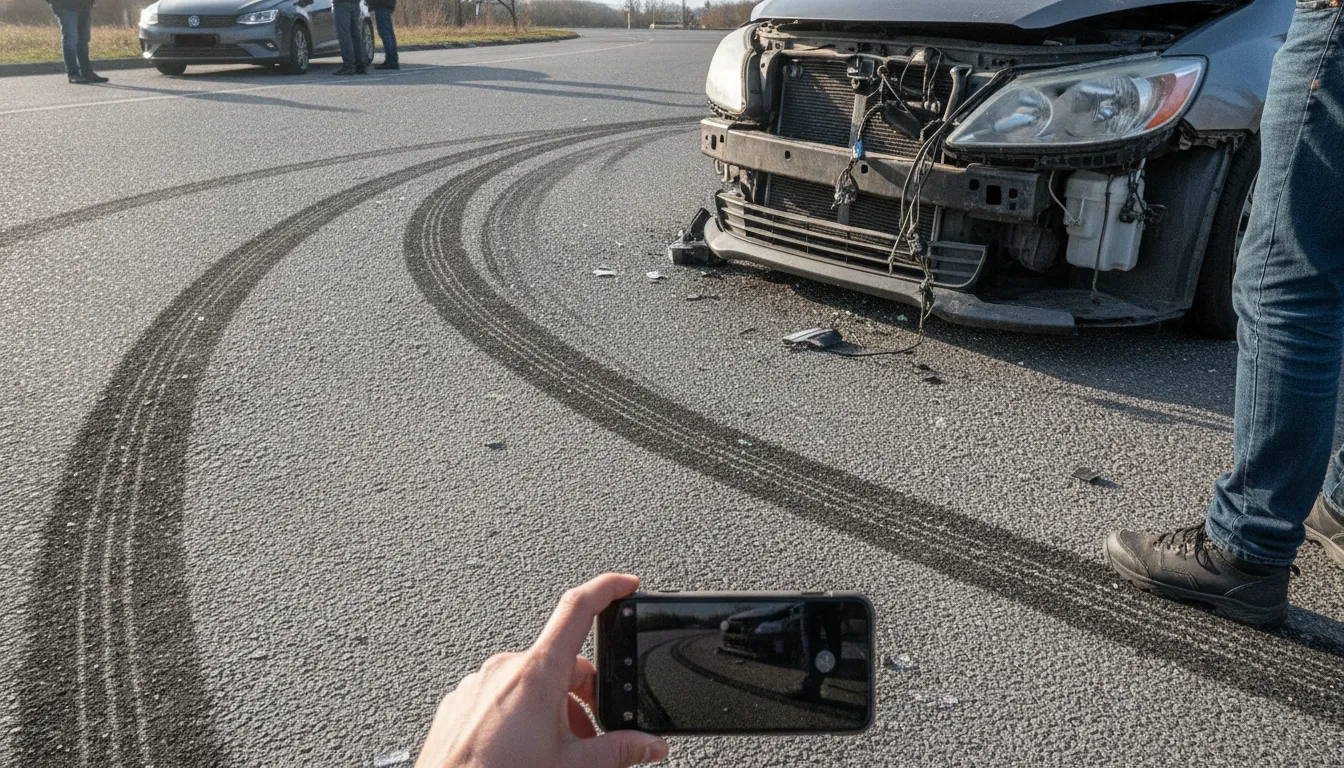
Adjusters and, if it comes to it, a jury, trust what was recorded over what people remember a week later. Walk the scene once before tow trucks and street sweepers change it. You are not building a case file in the moment. You are keeping the adjuster from filling the gaps with a story that favors the other driver.
- Each vehicle from all four corners, plus the damage up close and the license plates.
- The intersection, lane markings, signals, and any debris or skid marks, shot from the direction you were traveling.
- Weather, lighting, and road condition. Glare on MacArthur at dusk and standing water after a storm both matter.
- The other driver’s license, registration, and insurance card. Photograph them. Do not rely on a photo they text you later.
- Visible injuries, torn clothing, and the inside of your car, including deployed airbags and a cracked windshield.
- Nearby businesses or cameras. A gas station on Culver or an office lobby on MacArthur may have a view the police report never mentions.
Write down names and phone numbers of people who stopped, even if they say they “did not see much.” A short note about where they were sitting in traffic is enough. Our separate guide on why a car accident witness can make or break your case covers how those statements get used later. At the scene, the only job is getting a way to reach them.
Do not argue fault in the roadway, and do not post the photos. An apology, a “my insurance will handle it,” or a public caption can be quoted back to you. Exchange the information the law requires: name, address, driver’s license, registration, and proof of insurance. Then stop talking about how the crash happened.
Ask for the Irvine report, and know when there is not one
A police report is not the lawsuit, and it is not required for every fender bender. It is still the document insurers ask for first. If officers come, get the agency name, the officer’s name, and a report number or incident number before you leave. Irvine Police do not hand you the full report at the curb.
Irvine PD lets a driver, a vehicle owner, an injured person, or an insurer request a traffic collision report. The Irvine Police records page lists a $10 report fee, plus a card convenience fee, and says some requests need a detective’s review before anything is released. The Business Desk is open Monday through Friday, 8 a.m. to 7 p.m., and Saturday, 9 a.m. to 1 p.m. You can check release status at (949) 724-7062. Electronic copies come from the records unit, not from a reply to a random email.
If nobody was hurt and the cars were drivable, officers may not come at all. That does not erase the claim. It does mean your photos, the insurance cards, and a same-day written account carry more weight. Read how insurance works after a no-police-report car accident before you let an adjuster tell you there is nothing to file.
Freeway crashes are different. A CHP report uses a different request path than an Irvine PD report. Write down which agency actually arrived. Asking Irvine records for a CHP crash, or the reverse, costs days you do not have.
Two clocks start the day of the crash
People mix these up, and the mix-up is expensive. One clock belongs to the police. The other belongs to the DMV. Neither one is your insurance company’s deadline, and neither one is the lawsuit deadline.
| Deadline | Timing | Where it goes | Why Irvine drivers should care |
|---|---|---|---|
| Injury report to law enforcement. | Within 24 hours if anyone is hurt or killed. | Irvine Police on city streets. CHP on the freeways. | Both insurers ask for this report. |
| DMV SR-1 crash report. | Within 10 days. | California DMV. Not the police. | File it if anyone is hurt, or if damage to any one person exceeds $1,000. |
| Notice to your own insurer. | As soon as you can. Often the same day. | The company named on your insurance card. | Delay lets the other carrier frame the crash first. |
| Personal injury lawsuit. | Generally two years. | Orange County Superior Court. | A city or OCTA vehicle can cut the first notice to six months. |
The Driver’s Handbook is plain about the 24-hour piece. If anyone is injured or killed, you must report the collision to law enforcement within 24 hours. Your agent or a lawyer can make that report. Each driver must also file an SR-1 with the DMV within 10 days. That duty applies when property damage is more than $1,000, or when anyone is hurt or killed. It applies to a minor injury. It applies on private property. A police report does not replace the SR-1. The DMV says the same thing on its SR-1 accident reporting page. You, your agent, your broker, or your legal representative files it. Failing to file can suspend your driving privilege.
Most Irvine crashes with any real body damage clear $1,000 before the tow bill arrives. Do not talk yourself out of the form because the other car “looked fine.” The step-by-step for the form itself is in how to file a California DMV SR-1 after an accident. File it. Do not treat this article as the form.
Call your insurer, then be careful what you say
You should tell your own insurance company about the crash promptly. You do not owe the other driver’s insurer a recorded statement on the day of the collision. Do not guess at speed, distance, or injuries you have not had checked. “I feel okay” is a sentence adjusters keep.
California’s minimum liability limits, as the Driver’s Handbook states them, are $30,000 for injury or death of one person, $60,000 for injury or death of more than one person, and $15,000 for property damage. Those numbers are a floor, not a measure of what an injury is worth. A surgery, a month of missed work, or a rideshare policy with more than one layer of coverage will not fit inside a minimum policy. If the other driver has no insurance, your own uninsured-motorist coverage may be the practical source of payment. Ask your insurer what you carry before you accept a small property-damage check.
A few calls create problems that are hard to undo:
- A recorded statement to the other carrier before you have photos, the report number, and a medical visit.
- Signing a medical release that covers your entire history, not the crash.
- Accepting a check that says it settles “any and all claims” when you have only talked about the bumper.
- Posting about the crash, the other driver, or how you feel.
Get medical care the same day if anything hurts, and go even if it does not, when the impact was hard. Irvine and the rest of Orange County have emergency rooms and urgent care that can document a baseline. Delayed pain is common. Our page on delayed symptoms after a car accident in California lists what people notice days later. Tell every provider the visit is from a specific crash, on a specific date, at a specific Irvine location.
What changes the next step on Irvine roads
Not every crash needs the same phone call. The corridor and the kind of vehicle decide which facts expire first.
Freeway pileups on the 405, the 5, and the 55
These are CHP scenes, often with several cars and a short window before vehicles are towed to different yards. Photograph your lane position before you are waved forward. If a truck or delivery van is involved, get the company name on the door and any USDOT number, not just the driver’s personal insurance card. Commercial policies and the driver’s own policy are not the same thing.
Jamboree, MacArthur, Alton, and Culver
These are wide, fast city streets. Left-turn and red-light crashes are common, and the signal phase is the fact that disappears. Note whether you had a green arrow or a flashing yellow, and whether a camera or a business faces the intersection. A red-light photo is not the whole case, but it beats two drivers swearing at each other a month later.
Rideshare and parked-car damage
If an Uber or Lyft was involved, screenshot the trip screen before you close the app. The app record shows the driver, the time, and whether a trip was active. If you hit a parked car and cannot find the owner, leave a written notice. Vehicle Code section 20002 requires your name and address, plus notice to the local police without unnecessary delay. A note under a wiper is not optional color. It is the statute.
A city bus or a city vehicle
An OCTA bus or a City of Irvine vehicle is not an ordinary insurance claim. Claims against a public entity in California generally require a written government claim within six months, not the two years people expect for a private driver. Say so on day one if a public bus or a city car is in the photos. Missing that notice can end the claim before anyone talks about injuries.
Where Deldar Legal fits in the first week
Deldar Legal is a California personal injury firm. The Orange County office is at 19800 MacArthur Blvd., Suite 300, Irvine, just off the 405 and near John Wayne Airport. In-person meetings there are by appointment. Phone and video consultations are available around the clock, which matters when a crash happens after the Business Desk has closed and you still have a 24-hour report to make.
The firm has recovered more than $250 million for clients. That figure is a total across many cases. It is not a promise about yours. Every crash turns on the facts, the coverage, and the medicine. The first days are narrower than a trial. The work is to preserve the scene evidence, line up the right report, and notify the right insurers. The firm also coordinates care. When it fits, that includes treatment on a medical lien, so you are not choosing between a doctor and rent.
You still decide whether to hire anyone. Many people handle a pure property-damage claim with their own insurer and never need a lawyer. Talk to someone when there is an injury, a disputed light, a rideshare or truck, a public vehicle, or an insurer pushing a recorded statement or a fast release. The car accident practice pages describe the kinds of cases the firm files. The Irvine office page is the local starting point.
Request a free consultation or call (844) 335-3271 before the witness list goes cold. Bring the photos, the insurance cards, and any report number you already have.
FAQ: questions after an Irvine car accident
Do I have to wait for Irvine Police before I move my car?
No, if nobody is hurt and the car can move. The Driver’s Handbook tells you to get out of traffic first, then call 911. If someone may be injured, or the car is not drivable, stay put if you can do that safely and let dispatch tell you what to do.
Is a police report the same as the DMV SR-1?
No. Irvine Police or the CHP write the collision report. You, your insurer, or your lawyer file the SR-1 with the DMV within 10 days when someone is hurt or killed or property damage to any one person is over $1,000. One filing does not complete the other.
What if the other driver will not share insurance?
Photograph the plate and the car, and call the police. Vehicle Code section 20002 requires drivers in a property-damage crash to share name, address, license, and registration on request. Refusing and leaving can turn a civil dispute into a hit-and-run investigation. Your own uninsured-motorist coverage may still apply.
Should I talk to the other insurance company the same day?
You can report the crash to your own insurer. You do not have to give the other insurer a recorded statement, a medical release, or an account of who ran the light before you have looked at the damage and seen a doctor. A short factual notice is enough until you know what was hurt.
How long do I have to file a lawsuit?
For most California injury claims the deadline is two years from the crash. If a city vehicle or an OCTA bus is involved, the government-claim notice is generally six months. Those deadlines are separate from the 24-hour police report and the 10-day SR-1.
This article is general information about California crash-reporting rules and what to save after a collision in Irvine. It is not legal advice for your facts. Deadlines and insurance duties depend on the crash, the vehicles, and the coverage. If you were hurt, talk with a lawyer before you sign a release or give a recorded statement.