

A collision on a Berkeley street can leave you dealing with pain, a damaged vehicle, insurance calls, and uncertainty about what to do next. A Berkeley California car accident lawyer can help you understand the next steps, but there are also important things you can do immediately to protect your health and preserve useful evidence. This guide explains a practical California post-crash checklist, how local details can matter, and when a case evaluation may be worthwhile.
Call (844) 335-3271 for a free California car-accident case review
What to do immediately after a Berkeley collision
Your first responsibility is safety, not proving fault. If the crash is still creating a hazard, move to a safe location only if you can do so without worsening an injury or creating another danger. Turn on hazard lights, call 911 for injuries or an unsafe roadway, and follow the instructions of emergency responders.
Once everyone is safe, work through these steps as calmly as possible:
- Check for urgent injuries. Do not refuse emergency care simply because symptoms seem manageable. Some neck, back, head, and internal injuries become more noticeable later.
- Exchange identifying and insurance information. Record each driver’s name, contact information, driver’s license details, vehicle plate, vehicle identification number when available, and insurance information.
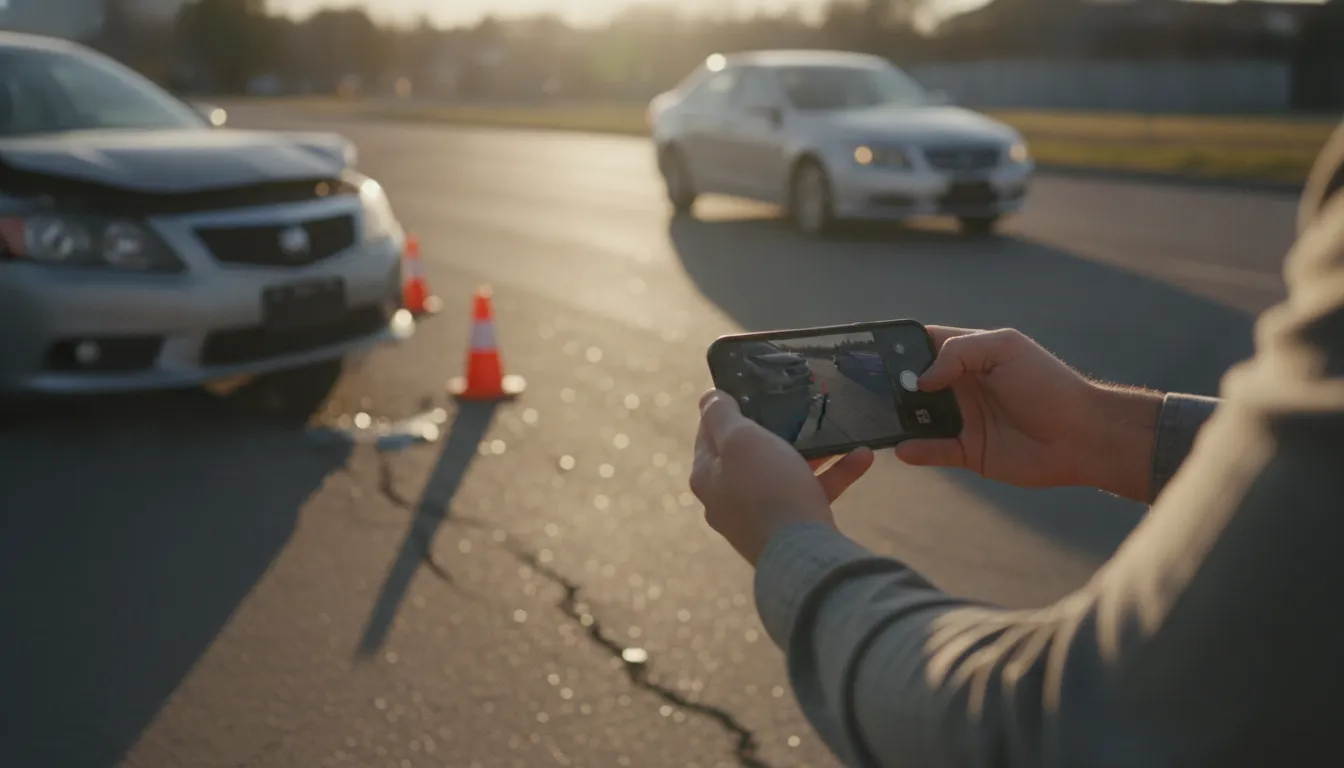
- Document the scene if it is safe. Photograph vehicle positions, damage, traffic controls, lane markings, debris, skid marks, lighting, weather, and any condition that may help explain what happened.
- Identify witnesses. Ask for names and reliable contact information. A witness who saw the signal, lane movement, or sequence of impacts may be important later.
- Keep your statements factual. Be courteous, but avoid guessing about speed, distance, or fault. Do not argue at the scene or post a theory about the crash online.
- Arrange medical follow-up. Follow discharge instructions and tell the provider how the collision happened, even if pain develops gradually.
California law also imposes duties after a collision. California Vehicle Code section 20001 addresses crashes involving injury or death, while section 20002 addresses crashes involving property damage. Both provisions generally require a driver to stop and provide information; the specific duties depend on the facts. Read the official text of Vehicle Code section 20001 and Vehicle Code section 20002 for the statutory language.
A Berkeley crash checklist for the first 24 hours
The details that seem small at the scene can become difficult to reconstruct a week later. Use this checklist to create a contemporaneous record without trying to decide the legal outcome yourself.
| Task | What to preserve | Why it can matter |
|---|---|---|
| Safety and emergency response | 911 information, responding agency, incident or report number, and emergency instructions | Creates a starting point for the official record and documents immediate concerns |
| Scene documentation | Wide and close photographs, intersection or roadway details, weather, lighting, and visible hazards | Helps preserve conditions that can change before an inspection |
| People and vehicles | Driver information, insurance details, witness contacts, and photos of every involved vehicle | Supports identification and later communication about the claim |
| Health records | Discharge papers, prescriptions, appointment dates, symptoms, and transportation costs | Connects treatment and out-of-pocket losses to the collision timeline |
| Electronic evidence | Dashcam files, phone photos, messages about the crash, and vehicle data information | Digital files can be overwritten, compressed, or lost if not saved promptly |
| Insurance communications | Claim number, adjuster name, letters, emails, estimates, and a call log | Creates a clear record of what was requested and when |
Do not edit, crop, or filter original photographs before saving a copy. Keep the original files and create a separate folder for documents you share. If a witness sends a video, ask the person to preserve the original file rather than forwarding only a screen recording.
How the location and roadway details can help
A Berkeley collision claim is not decided by the city name alone. The precise location, direction of travel, lane position, traffic control, visibility, and sequence of impacts may all be relevant. Write down the nearest intersection, the direction you were traveling, the lane you occupied, the intended movement, and where each vehicle came to rest. If the crash occurred near a freeway entrance, construction area, bicycle facility, crosswalk, parking lot, or transit stop, note that context without assuming it proves fault.
Preserve the names of nearby businesses, residences, or public facilities that may have exterior cameras. Video systems often overwrite footage on a short schedule. A lawyer can help identify a reasonable preservation request, but you should not trespass, pressure a witness, or attempt to obtain restricted footage yourself.
If Berkeley police or another agency responded, keep the incident details and follow the agency’s process for records. The City of Berkeley Police Records page explains how records requests are handled. If the collision occurred on a state highway, the responding agency may be the California Highway Patrol rather than Berkeley Police. The correct records source depends on where the crash occurred and which agency investigated it.
California DMV reporting is separate from a police or insurance report
California’s DMV requires an SR-1 Report of Traffic Accident Occurring in California when anyone is injured or killed, or when property damage is more than $1,000. The report generally must be submitted within 10 days. The requirement applies even when the crash was investigated by police or reported to an insurance company.
Review the California DMV’s SR-1 instructions for the current filing process and information to gather. The DMV explains that you, your insurance agent, broker, or legal representative can complete the report. Keep proof of submission and a copy of what you sent.
An SR-1 is not the same thing as a demand letter or a lawsuit. It is an administrative accident report, and it does not decide who was legally responsible. If you are unsure whether the threshold applies, gather the information promptly and consider obtaining advice before the deadline. A separate Deldar guide explains how to file a California DMV SR-1 after an accident.
What to say to insurance companies after a crash
Notify your own insurer promptly and give an accurate account of what happened. Ask for the claim number, the adjuster’s contact information, and written instructions about property damage, medical-payments coverage, vehicle inspection, and rental transportation. Keep copies of photographs, estimates, receipts, and every communication.
The other driver’s insurer may contact you quickly. You can be truthful and cooperative without speculating about fault or giving a recorded statement before you understand what is being requested. Do not sign a release or accept a settlement before you know the scope of your injuries, the available insurance coverage, and what claims the document would close. An insurer’s initial offer is not a neutral evaluation of your long-term losses.
For general consumer guidance, the California Department of Insurance accident guide discusses reporting a collision, documenting losses, and communicating with insurers. Deldar also explains how insurance may work when no police report was made. A missing police report does not automatically answer whether an injury claim can be evaluated, but it can make timely witness and evidence preservation more important.
Build an injury and loss record without overstating anything
Medical care comes first. Tell providers about all symptoms and follow reasonable treatment instructions. Keep a simple daily record of pain, sleep disruption, mobility limits, missed work, medication side effects, and activities you cannot perform. Avoid exaggeration, but do not minimize symptoms to appear tough. A consistent record helps show how the collision affected ordinary life.
Keep documents for emergency care, visits, imaging, prescriptions, physical therapy, mileage, rides, vehicle storage, repairs, rental transportation, and damaged personal property. Save pay stubs, schedules, employer communications, and other records that show missed work or reduced capacity. If you are self-employed, preserve ordinary business records that may help explain a change in income.
Potential losses can include medical expenses, lost earnings, property damage, and non-economic harm such as pain and disruption of daily activities. What may be recoverable depends on the facts, evidence, insurance, medical history, and applicable law. No lawyer can responsibly promise a particular result from a short description of a collision.

Evidence that may help explain who caused the collision
Fault analysis is fact-specific. Evidence may include the police or incident report, scene photographs, vehicle damage patterns, witness accounts, traffic-signal timing, dashcam footage, nearby surveillance, phone records when legally obtainable, and vehicle event-data information. Preserve what you have; do not attempt to access another person’s phone, vehicle data, or private account.
Vehicle damage can help investigators understand impact direction, but photographs alone do not automatically establish fault. A vehicle inspection should be performed by an appropriate professional, and repairs should be documented with estimates, invoices, and photographs. If the vehicle may contain event-data information, ask about preservation before it is repaired, sold, salvaged, or altered. Deldar’s guide to event data recorder and black-box crash evidence covers why electronic evidence can require special handling.
California follows a comparative-fault approach in many negligence cases. If more than one person or entity contributed to an injury, the allocation of responsibility and the effect on damages depend on the evidence and legal analysis. That is one reason a careful case evaluation should examine the full collision sequence instead of relying only on an initial insurance conclusion.
Deadlines can affect a Berkeley injury claim
Do not wait for a deadline to approach before getting organized. California personal-injury and property-damage claims can involve different limitation periods, and special rules may apply to minors, public entities, government vehicles, uninsured motorists, or claims involving a death. A claim involving a public roadway or public employee may have an administrative claim requirement before a lawsuit can proceed.
The law can change and the correct deadline depends on the parties and facts. For general reference, California Code of Civil Procedure section 335.1 addresses certain injury and death actions, section 338 addresses certain property-damage actions, and Government Code section 911.2 addresses claims against public entities. Review the official text of Code of Civil Procedure section 335.1 and speak with a qualified California attorney about the deadline that applies to your situation.
Sending an insurance notice does not necessarily stop a statute of limitations. If you are approaching a deadline, or if a public agency may be involved, seek advice promptly rather than assuming the claim is protected by an open insurance file.
When to speak with a Berkeley-area car accident attorney
A consultation may be useful when the crash caused an injury, the other driver disputes what happened, multiple vehicles are involved, the available insurance is unclear, a commercial or rideshare vehicle is involved, a loved one cannot manage the claim, or the insurer asks you to sign a release. It can also help when a collision involves a pedestrian, bicyclist, motorcyclist, child, older adult, or a potentially dangerous roadway condition.
Bring the claim number, insurance correspondence, photographs, medical records, wage information, repair documents, witness contacts, and your timeline if you have them. You do not need to have a perfectly organized file before asking questions. A lawyer can explain what information is missing and whether the facts support further investigation.
Deldar Legal handles California auto-accident matters, including serious injuries, rear-end collisions, hit-and-runs, multi-vehicle crashes, and property-damage issues. The firm reports more than $250 million in recoveries, but past results do not predict a future outcome. Every case depends on its own facts, evidence, insurance, and applicable law. You can review the firm’s California auto-accident practice page and attorney team before deciding whether to request a consultation.
Call (844) 335-3271 or request a free consultation online to discuss what happened and what to preserve next.
Frequently asked questions
Do I need a lawyer after every Berkeley car accident?
No. A lawyer may be especially helpful when there is an injury, a disputed account, significant property damage, an uninsured or underinsured driver, multiple responsible parties, or pressure to accept a release. For a minor property-only event, you may choose to handle the insurance process yourself, but keep a complete record and watch for symptoms.
What if I did not call the police?
A missing police report does not by itself decide whether a claim exists. Report the collision to your insurer, preserve photographs and witness information, obtain medical care when appropriate, and check whether an SR-1 is required. The available evidence and the circumstances of the delay will matter.
How soon must I report a Berkeley collision to the DMV?
The California DMV says an SR-1 is generally due within 10 days when someone is injured or killed or property damage is more than $1,000. It is separate from a police or insurance report. Confirm the current instructions on the DMV website and keep proof of filing.
Should I accept the other driver’s insurer’s first settlement offer?
Do not sign a release until you understand what claims it would end and whether you know the extent of your injuries and losses. An attorney can review the offer, but no one can evaluate a claim responsibly without the relevant records and facts.
What should I bring to a free case review?
Bring your insurance information, the other driver’s information, claim correspondence, photographs or video, medical documents, wage records, repair estimates, receipts, witness contacts, and a short timeline. If you do not have everything, contact the firm anyway and explain what is available.
After a Berkeley collision, focus first on safety and medical care, then preserve the facts before they disappear. If you want help evaluating the next step, call (844) 335-3271 or request a free consultation. A review is informational and does not create an attorney-client relationship until the firm confirms the representation.